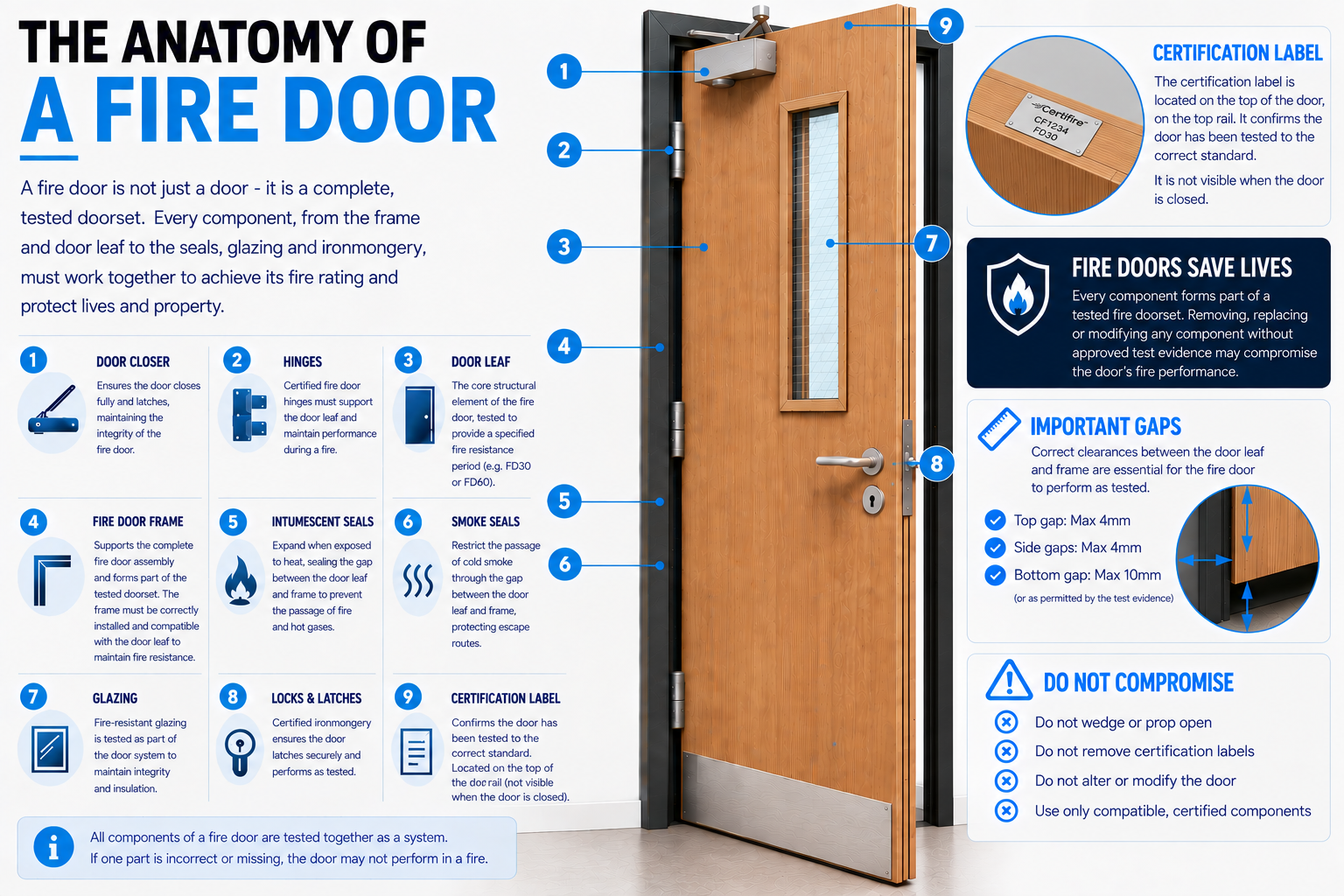
A fire door is often thought of as just another door with a fire rating. In reality, it’s much more than that. A fire door is a carefully tested complete system of components, each playing a critical role in containing fire and smoke for a specified period.
If just one component is missing, substituted with a non-compatible product, or installed incorrectly, the entire door assembly may no longer perform as it was tested. That’s why understanding the anatomy of a fire door is essential for architects, specifiers, contractors and fire door installers.
In this guide, we’ll break down every key component of a fire door and explain how they work together to protect lives and property.
A fire door isn’t a collection of individual products that happen to fit together. It is a complete, tested assembly that has been fire tested as a single unit in accordance with recognised standards.
The certification applies to the entire door set or door assembly, including:
Every one of these components has been selected because it contributes to the overall fire performance. Replacing one element with an untested alternative can invalidate certification and significantly reduce fire resistance.
This is why fire door inspections don’t just look at the door, they examine every individual component.
Door closers ensure that the door:
A wedged-open fire door offers no fire protection.

Hinges carry the full weight of the fire door throughout its service life.
More importantly, during a fire they must continue supporting the door despite extremely high temperatures.
Certified fire door hinges are tested for:
Using non-certified hinges can cause the door to distort or fail prematurely.

The door leaf forms the core of the fire door set.
Unlike a standard timber door, a fire door leaf is manufactured using specially engineered cores and facings designed to resist fire for a specified period, commonly:
The door leaf has been tested alongside every other component, meaning even drilling additional holes or making unauthorised alterations can affect performance.

The frame is often overlooked, but it is just as important as the door itself.
The frame:
A high-quality fire door frame must be compatible with the tested door assembly.

When people search for fire door seals, they’re often referring to two different products:
Although they are different, they work together to protect escape routes and limit fire spread.
Intumescent seals remain inactive during normal use.
When exposed to high temperatures, they expand many times their original size, sealing the gap between the door leaf and frame.
This expansion:
Without intumescent seals, flames can quickly penetrate the gaps around a fire door.

Smoke is responsible for more fire-related fatalities than flames.
Smoke seals help prevent the movement of toxic smoke before temperatures become high enough for intumescent seals to activate.
These seals:
Many modern fire door seals combine both intumescent and smoke sealing into one product.

Vision panels provide visibility, improve safety and allow natural light to pass through corridors.
However, ordinary glass cannot be used in a fire door.
Fire-resistant glazing is specially tested alongside:
Each element must remain compatible with the tested system to maintain the fire rating.

Every piece of ironmongery hardware installed on a fire door has an important role.
Fire-rated locks and latches are tested to ensure they:
Even seemingly minor hardware changes can affect certification if the replacement products haven’t been tested within the door system.
One of the most common reasons a fire door fails inspection is incorrect installation gaps.
Always refer to the manufacturer’s installation instructions and applicable test evidence for the permitted gaps.
Typical guidance recommends:
Excessive gaps allow smoke and hot gases to pass through long before the fire rating is reached.
Correct installation is just as important as selecting the right components.
It can be tempting to replace worn hardware with an equivalent-looking product.
Unfortunately, fire doors don’t work that way.
Every component has been tested together as part of a complete fire door system.
Changing even one item, including seals, hinges, glazing or ironmongery may invalidate the fire test evidence unless the replacement has been assessed as compatible.
For architects and specifiers, this means specifying complete systems rather than individual products. For installers, it means following the manufacturer’s installation guidance and using certified components throughout.
A certification label confirms that the fire door has been manufactured and tested to recognised standards.
The label provides traceability and confirms the performance of the door assembly.
It should never be:
Without certification, proving compliance becomes significantly more difficult.
A fire door is only as strong as its weakest component.
The door leaf, frame, glazing, hinges, closer, locks and fire door seals must all work together exactly as they did during fire testing.
Now that you understand how each component contributes to the performance of a fire door, why not put that knowledge into practice?
We’ve created a FREE Fire Door Component Inspection Checklist to help you carry out routine visual inspections and identify common issues with fire door assemblies.
Whether you’re a facilities manager, contractor, installer or responsible person, it’s a practical resource to keep on hand when inspecting fire doors.
At Sealmaster, we understand that effective fire protection depends on complete, tested systems rather than individual products. That’s why we supply a range of certified fire door seals and passive fire protection solutions designed to support compliant installations and help maintain the integrity of every fire door assembly.
If you need support with a fire door or passive fire protection application, our experienced technical team is here to help. We offer free technical advice and site visits, helping you identify suitable sealing solutions for your specific application.
Need technical advice or would like to arrange a site visit? Contact our team at [email protected].
 August Roundup
 Guard What Matters with Fire Face
 Discover Acoustic Cold Smoke Seals
 Product Focus: July
 Have a question for us?
 White Glazing Tape – Product Focus
A Sealmaster expert is on standby with all the information you need for your sales related enquiries and to provide you with all the technical information you need for your bespoke solution or product.






 01223 832851